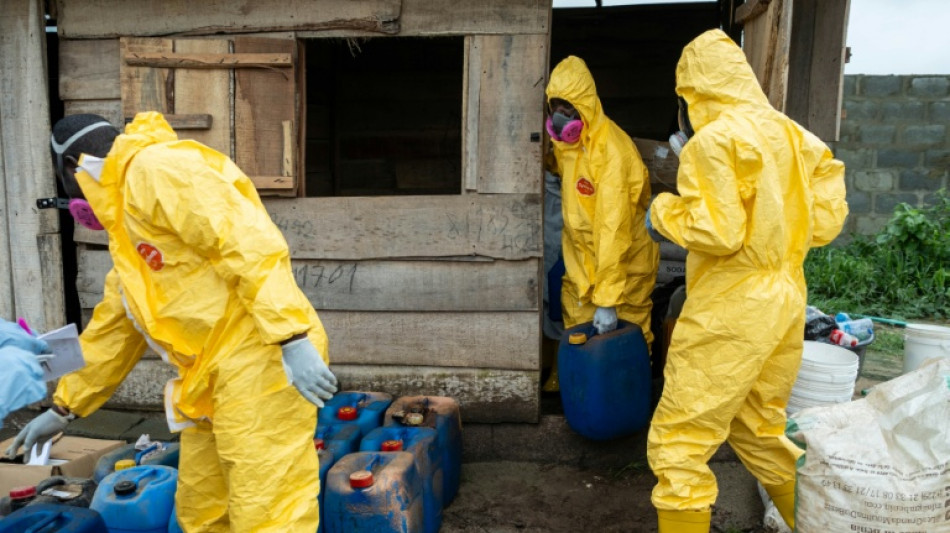
Nigeria dismantles meth lab, but fears of Mexican cartel links linger / Photo: TOYIN ADEDOKUN - AFP

The cooking cauldrons and vats of chemicals were left behind in an abandoned shed, hidden in a Nigerian forest -- remnants of an alleged multimillion-dollar transnational meth operation.
Authorities Wednesday dismantled the crude, makeshift meth lab after an ongoing trial involving three Mexican nationals took a day to hold court proceedings on-site last week.
AFP visited the lab, in southwestern Ogun state, with officers from the National Drug Law Enforcement Agency (NDLEA) as they brought in a local welder and carpenter to dismantle the cauldrons and filtration equipment used to make the meth.
West Africa in recent years has emerged as a transit point for drugs making their way from South America to Europe -- mostly cocaine.
But the meth bust -- which nabbed the largest such lab ever discovered in Nigeria -- points to Mexican cartel involvement in the country, local authorities have said. "About our readiness to combat the cartel... yes, we are ready," James Taalba, the NDLEA's deputy commander of narcotics, told AFP.
"We have people who are capable of curtailing such a situation."
The lab sat on an acre of land in a forest that straddles the border of Abidagba and Iroto villages.
In May, authorities arrested 10 people -- including seven Nigerians -- and raided the facility, as well as two residential properties in an upscale Lagos neighbourhood, netting $360 million worth of meth and the chemicals used to make it.
Legal proceedings are still underway, in court -- and back indoors -- in Lagos.
The court ordered the lab dismantled for environmental reasons, said Patricia Afolabi, the NDLEA's director of forensics, citing groundwater and air pollution from the chemicals used to make the drug.
Barrels of chemicals and partially finished product had been left in the shed as evidence, still emitting choking vapours when AFP visited.
- International trafficking, local production -
West Africa's ports have become popular stopover points for transcontinental cocaine shipments bound for Europe, and some contraband slips into domestic drug markets -- a development the region's poorly funded health services can hardly handle.
Other substances like meth can be produced locally.
Meth seizures and raids on labs in Nigeria have been on the rise since around 2011, according to a 2019 report from the Institute for Security Studies, as Latin American specialists exported their expertise to the country.
Another Mexican national was arrested in a meth bust in June, in Oyo state.
Florence Banjo, a local farmer, said that the stench from the meth lab would sometimes drift into her nearby village of Abidagba, about a kilometre away.
While some farmland came within 500 metres of the site, the lab was hidden by forest.
Banjo thought the smell was coming from a pigsty -- she never imagined it coming from a meth lab.
The flurry of movement and construction around the site initially gave her hope.
"We heard rumours that they were going to build (a housing) estate there, and I was happy that they'd finally pave the road that leads into our village," the 59-year-old told AFP.
"We were disappointed."
Z.Vega--GM