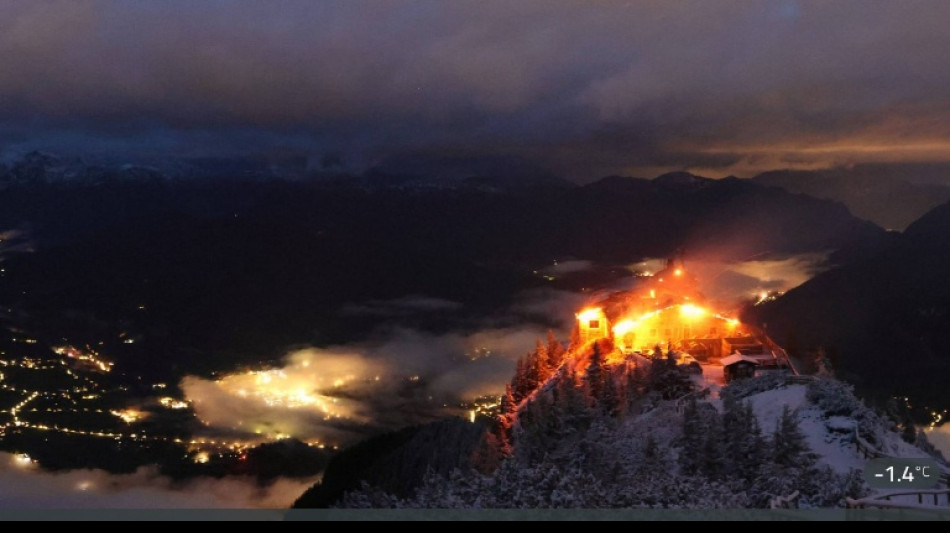
Fire breaks out at Hitler's mountain retreat, suspect arrested / Photo: - - AFP

German police said Saturday they had detained a suspect following a fire at Adolf Hitler's mountain retreat, known as the Eagle's Nest, in the state of Bavaria.
Around 200 firefighters were deployed to tackle the blaze at the Nazi dictator's remote and difficult-to-access Kehlsteinhaus residence, on the peak above Obersalzberg in southern Germany.
Firefighters saw flames rising high into the air as they approached the scene, only to find the building "completely ablaze", police said.
"A suspicious person was taken into temporary custody," they said in a later statement, adding that nobody was injured in the blaze.
Police spokeswoman Lisa Maier said firefighters struggled to tackle the fire due to its location at an altitude of 1,834 metres (6,000 feet).
The building was only accessible with "heavy breathing apparatus", she said.
Authorities were alerted to the fire on Friday evening, when a smoke detector triggered a fire alarm at around 9:50 pm (1950 GMT), police said.
No potential reason for the fire was given, but German media reported that the investigators suspected it was the result of arson.
As snow fell on the Alpine peak, the Eagle's Nest was still engulfed in flames in the early hours of Saturday, a weather camera showed. The blaze appeared to have been doused by Saturday morning, although smoke continued to rise from the smouldering building.
- Monument to Hitler -
Officers blocked access to the road leading to the retreat, an AFP photographer saw.
The firefighters found no one inside the building.
Maier, the police spokeswoman, said the investigation was still ongoing. The police have planned a news conference later Saturday.
German tabloid Bild reported that the authorities arrested a motorcyclist they came across on their way to the scene.
Built between 1937 and 1938, the Eagle's Nest forms part of the toxic legacy of Hitler's Third Reich, which was responsible for the deaths of millions of Jews along with Roma, LGBTQ people and Communists in the Holocaust.
It was designed to serve as a monument to Hitler's rule, though the dictator himself seldom visited the complex.
Built of stone and granite, the residence offers an exceptional view of the picturesque Bavarian Alpine landscape and was designed to impress foreign diplomats.
It survived the Second World War undamaged and later gained notoriety through its use as a shooting location in many post-war Hollywood films.
Since 1952, it has hosted both an exhibition recounting the house's Nazi history and a restaurant.
The website says the Eagle's Nest "stands for the insanity of the regime and the world on the Obersalzberg, where plans for war and mass murder were formed".
O.Moreno--GM