Warsaw and Kyiv exhume Volyn victims at centre of diplomatic quarrel / Photo: Serhii Okunev - AFP

Beneath two now-deserted villages in western Ukraine –- the site of WWII-era massacres -- archaeologists are uncovering the bones at the heart of a dispute that has strained relations between Warsaw and Kyiv for years.
Disagreements over what happened and who is responsible for the Volyn massacres have long cast a shadow over ties between the otherwise now close neighbours.
Between 1943 and 1945, some 70,000-100,000 civilians were killed by the Ukrainian Insurgent Army (UPA) in territory occupied by Nazi Germany, according to Polish estimates of the toll.
Warsaw calls it a "genocide" against the Polish minority, while Ukraine hails the UPA as freedom fighters, sees the events as a wartime "tragedy" and says that Ukrainians were killed in retaliation.
Amid sunflower fields and forests, joint Polish-Ukrainian teams of archaeologists have been carefully excavating the remains of victims.
"We want to restore their first and last names ... to fulfil the duty that rests on us as heirs of those who were murdered here," said Karol Polejowski, deputy president of the head of Poland's Institute of National Remembrance (IPN).
The remains of over 50 people have been recovered in a series of exhumations taking place in the area, but they have yet to be identified.
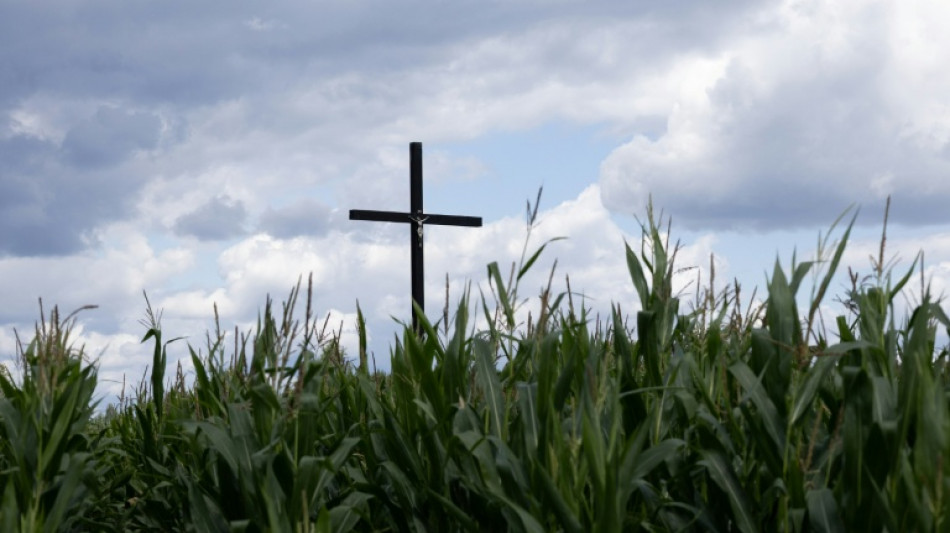
A handmade wooden cross, planted near the graves, is one of the few signs that the villages ever existed.
Political leaders in both countries believe the exhumations can be a first step in repairing relations, which have been strained this year by a row triggered when Ukrainian President Volodymyr Zelensky named a military unit after the UPA.
- 'Civilian population' -
In a white tent around 10 kilometres (six miles) from the Polish border, experts meticulously lay out the skeletons of recovered victims, measuring bones and carefully trying to match broken skull fragments.
A small number of other artefacts -- rosaries, religious medallions and shoes -- have also been unearthed under the field of yellow-and-black sunflowers, one of the national symbols of Ukraine.
"The remains were arranged in a highly disordered manner. Most of the bodies had been brought to the burial pit and simply dumped into it," Olga Mineiko, an anthropologist at the Ukrainian Memorial and Search Center, told AFP on the site.
The victims were likely "driven to the field of death barefoot and without personal belongings," said Polejowski.
The genetic material is collected, with the IPN appealing to Poles who believe they may have lost relatives in the massacre to provide their own to help find matches.
Forensic specialists and anthropologists will also examine the bones to determine the approximate age, sex and cause of death of each of them.
It is believed that between 30 to 40 percent of the 50 remains so far discovered at the site were children, according to Polejowski.
- Diplomatic spat -
The massacres have been a recurring point of contention between Warsaw and Kyiv.
The UPA was a paramilitary organisation tied to the Ukrainian independence movement that fought the Soviet Union's Red Army.
But it collaborated with the Nazis when they first invaded the Soviet Union, clashed with the Polish resistance and killed Poles, Jews and other civilians.
Since Russia invaded in 2022, the UPA has been honoured in Ukraine as a force that fought for independence from Moscow under the Soviet Union.
Kyiv insisted Zelensky's choice of name for the military unit was not directed against Warsaw.
But Polish President Karol Nawrocki withdrew Poland's highest national honour from him in response.
In Poland, the issue has become even more politicised as nationalist parties seek to embolden their base ahead of parliamentary elections next year -- part of a broader campaign to whip up anti-Ukrainian sentiment.
Poland is home to hundreds of thousands of Ukrainian refugees -- with a backlash against their presence having surged during a divisive presidential election campaign last year, won by the right-wing Nawrocki.
The country is still the main hub for military and humanitarian aid deliveries to Ukraine, and Prime Minister Donald Tusk's pro-European government has repeatedly called for a de-escalation.
Warsaw has welcomed efforts by Zelensky to cool the tension, including the promise of opening of classified intelligence documents.
As Tusk and Zelensky try to bury the hatchet, in the Ukrainian fields near the Polish border, plans are underway for a proper farewell to those uncovered.
"We want them to be buried here, where they lived, where each of them had their dreams and plans, and wanted their life to unfold," said Polejowski.
"In this soil they should rest."
J.Castro--GM