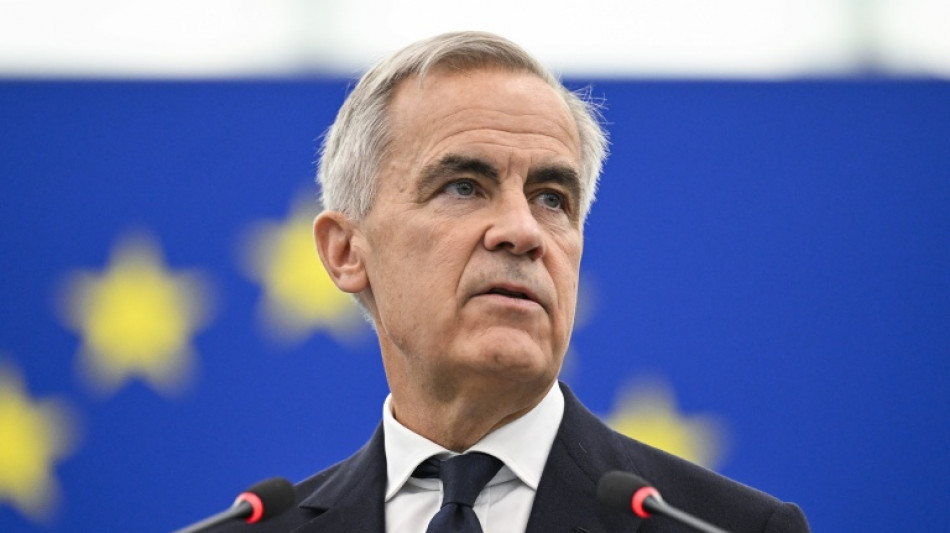
Carney moves to remake Canada alliances as US ties strained / Photo: Jean-Christophe VERHAEGEN - AFP

Canadian Prime Minister Mark Carney will try to secure unprecedentedly close ties with the EU when he hosts the bloc's leaders this week, with the possibility of a special "associate member" status even being raised.
But for Carney, who has assured Canadians they could trust him in a crisis, forging new agreements with Europe is just one piece of a plan to reposition Canada's place in the world in response to attacks from US President Donald Trump.
"America is trying to break us so that they can own us. And I promised that will never, ever happen. Our future won't be decided in Washington," Carney said in August when he dramatically broke off trade negotiations with Trump's team.
The US president's tariffs have stunted Canada's economy, and his annexation threats have stoked outrage.
Carney, a political novice before taking office last year, speaks bluntly about Trump, telling Canadians the president cannot be trusted to keep his word.
In August, he warned the US signature on commitments is sometimes "written in pencil." Asked Monday if Trump might sign a future deal in pen, Carney said: "I don't know that."
Carney thrived as an investment banker at Goldman Sachs before leading the central banks of Canada and England.
He has told Canadians he's an expert on the global economy and knows how to manage risk, arguing the country must move at breakneck speed to reduce dependence on the United States.
"We were used to things taking a very long time," University of Ottawa political scientist Genevieve Tellier told AFP.
Carney understood the "shock" of Trump's conduct would allow Canada "to do big things," and the prime minister is moving fast, she said.
- Reviving relations -
Beyond the EU, Carney has tried to restore relationships that endured thorny periods in recent years, visiting both China and India -- Asian powers that reduced or broke off ties during former prime minister Justin Trudeau's tenure.
Carney became the first Canadian prime minister to visit Saudi Arabia in a quarter century, declaring that he had no intention of publicly "lecturing" the kingdom about human rights.
Last week, he made the first-ever bilateral visit by a Canadian prime minister to Turkey.
The trips tried to advance his goal of securing tariff-free access to three billion consumers worldwide for Canadian businesses.
Carney also wants to quadruple defence spending by 2030.
"It's inevitable," said University of British Columbia political scientist Maxwell Cameron. If Canada sees "the United States as potentially a threat to our own sovereignty," it has to bolster national defence, he said.
Ottawa's decision to purchase a new fleet of submarines from the German firm Thyssenkrupp Marine Systems (TKMS) was also seen as a signpost of moves to come: procurement from key European NATO allies while diversifying military reliance away from the United States.
- Trump departure -
Carney is also backing a new oil pipeline to the Pacific coast, hoping Canada can export more oil to Asia. He also wants to accelerate major mining projects focused on critical minerals.
Cameron said he expects a "backlash" over moves seen as harming the environment.
Patrick Bonin, a federal lawmaker from the separatist Bloc Quebecois party, charged last week that environmental policy under Carney was "going back decades."
But Carney remains popular nationally, and Tellier argued the biggest threat to his standing will be Trump's departure.
Then he'll just be "a prime minister managing a normal situation," without an "imminent existential threat" from the US to rally national unity, she said.
Q.Gutierrez--GM