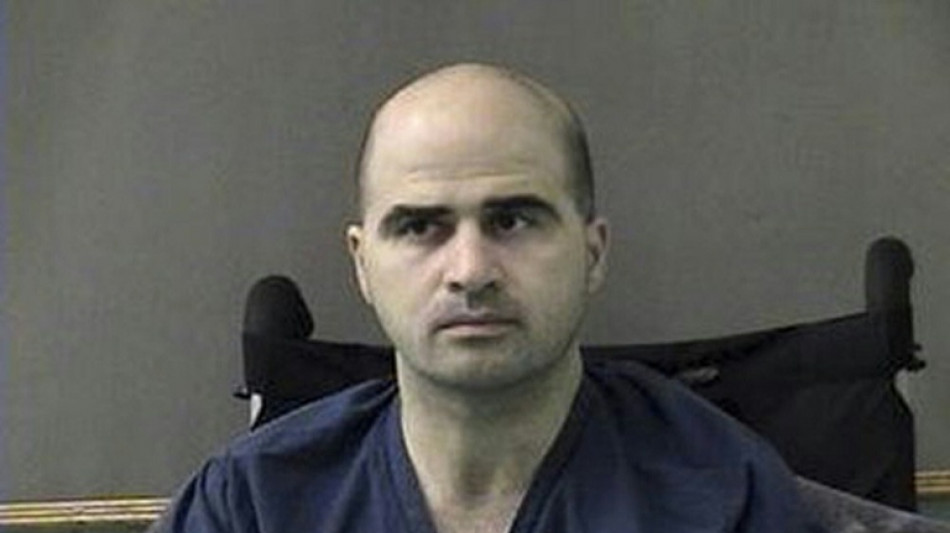
US military to livestream firing squad execution of Fort Hood shooter / Photo: Handout - BELL COUNTY SHERIFFS DEPARTMENT/AFP/File

The execution by firing squad of convicted military base shooter Nidal Hasan will be livestreamed, a Pentagon official said Thursday, after Defense Secretary Pete Hegseth said it would be carried out in "public."
Hasan, a US Army psychiatrist, shot dead 13 people at Fort Hood in 2009. His execution will be the first by the US military since 1961, and the first it has carried out by firing squad since World War II.
"It will be livestreamed. Details will follow," the Pentagon official told AFP on condition of anonymity.
Hegseth had said in a video posted on X by official Pentagon accounts earlier Thursday that Hasan is "going to get a firing squad of soldiers, as it should be, and we'll make sure that people are able to watch it, that it's public."
"People need to understand that...there's serious consequence for these types of things," Hegseth told right-wing influencer Jack Posobiec while aboard the USS Abraham Lincoln aircraft carrier.
Hegseth noted that it would be the military's first firing squad execution since the Second World War -- a reference to the case of Eddie Slovik, who was put to death for desertion in 1945.
"I kind of like the mentality we had in World War II, which was win, which was understand when the enemy attacks you, you need to stand your ground," Hegseth said.
In a separate clip, Posobiec asked the Pentagon chief if Hasan had made any final request.
"Don't care. We'll see him on December 3," Hegseth said -- the day Hasan is slated to die.
The last US military execution was carried out in 1961, when John Bennett was hanged for rape and attempted murder.
- Afghanistan and Iran -
According to rights group Amnesty International, at least 17 public executions are known to have been carried out in 2025 -- six in Afghanistan and 11 in Iran.
The Death Penalty Information Center says that 135 soldiers have been executed by the US military since 1916.
The Pentagon announced earlier this week that US President Donald Trump had approved Hasan's execution for carrying out the Al-Qaeda inspired attack.
Twelve of those he killed and 30 of the wounded were soldiers. Hasan was shot and partially paralyzed by a civilian police officer who responded to the attack.
He was sentenced to death by a military jury in 2013.
Hasan chose to conduct his own defense during the trial but called no witnesses and gave no testimony, and made no attempt to deny the charges. Court-appointed defense attorneys expressed concern that he was seeking execution.
The court that convicted Hasan was told he was opposed to the US military's occupations of Iraq and Afghanistan, and that he had spoken online with an alleged Al-Qaeda figure, radical cleric Anwar al-Awlaki, an American citizen subsequently killed in a US drone strike in Yemen.
While mass shootings in the United States are common, they are relatively rare at military facilities.
In 2025, a soldier opened fire at a US military base in the state of Georgia, wounding five fellow troops before he was tackled and apprehended.
In 2019, a US sailor fatally shot two people and wounded a third at a base in Hawaii, while a Saudi military student shot dead three people at a military facility in Florida the same year.
And a Kuwaiti-born US citizen attacked two military installations in Tennessee in 2015, killing four Marines and a sailor. The FBI concluded the violence was inspired by a "foreign terrorist group."
J.Martin--GM