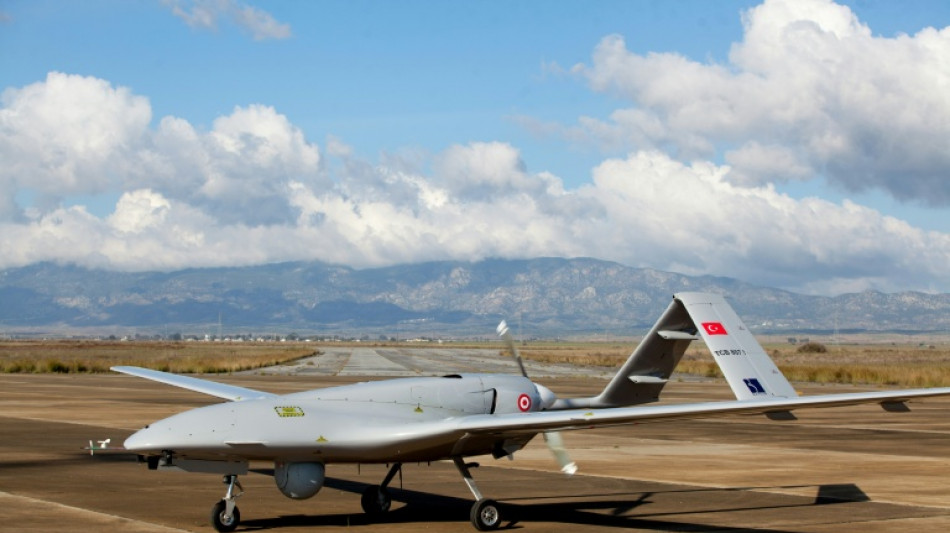
Ethiopia boosts drone production to fight rebels / Photo: Birol BEBEK - AFP/File

Ethiopia has been manufacturing drones at two factories since last year and is now thought to have a fleet of thousands, analysts say, giving the government an edge against its multiple insurgent enemies.
Turkish drones were decisive during the country's devastating civil war of 2020 to 2022, when the federal army used them to push back rebels from the northern Tigray region who had come within 200 kilometres (125 miles) of the capital, Addis Ababa.
Only the federal army has military drones in the country of 130 million people, and they have been deployed repeatedly against insurgents operating in several regions.
Increasingly, they are made domestically.
In March 2025, Prime Minister Abiy Ahmed inaugurated the SkyWin Aeronautics Industries factory in the capital, manufacturing "unmanned aerial vehicles for both civilian and military use", according to the state's Ethiopian News Agency, which said they were "designed and built by our own young professionals".
Abiy said the aim was not "not to fuel conflict, but to prevent it" through "deterrence".
But much of Ethiopia's capability remains a mystery, and the authorities have refused access to the site for foreign media.
"One hall with some shiny drones tells us little about what the real production capabilities are, and where the technology, key components or possibly complete kits come from," Pieter Wezeman, a researcher at the Stockholm International Peace Research Institute, told AFP.
"My assessment would be that a substantial part of all that is imported," he said.
Ethiopia has bought Turkey's top-end Akinci drones and the more basic Bayraktar TB2 models, as well as the cheaper Wing Loong from China and Mohajer-6 from Iran.
According to Jeremy Binnie of the defence and intelligence company Janes, the model displayed at the SkyWin inauguration, marked "SW01", closely resembled a commercially available Chinese model.
"Mass-producing these could potentially significantly increase your military effectiveness if every brigade had two or three to enable it to find the enemy and call in and adjust artillery fire," he said, adding that they could also be modified to carry small bombs.
A second factory, Aeroabay, was opened in late 2025, producing thousands of small weaponised drones that cost $5,000 to $10,000 each, according to Wim Zwijnenburg, a drone specialist for PAX, a conflict-resolution NGO.
These FPV (First-Person View) quadcopters allow pilots to scan terrain and can carry explosive payloads. Some are controlled by fibre-optic cables to prevent electronic jamming.
- 'Create terror' -
The conflict tracking group ACLED says federal forces have carried out 102 drone strikes in the northern Amhara region since an insurgency by the Fano militia began in April 2023, and have also deployed them against rebels in Abiy's home state of Oromia.
Drones have been "blamed for the deaths of civilians on various occasions", said Magnus Taylor of the International Crisis Group (ICG).
There have been at least 14 drone strikes in Tigray this year -- seven in August alone -- as fears mount of a return to full-blown civil war.
ACLED says the attacks sought to "disrupt mobilisation and planning" amid a forced recruitment campaign by the Tigrayan authorities.
The federal army appears to be deploying "remote-controlled, larger military drones that use glide bombs or missiles", according to Zwijnenburg.
Amanuel Assefa, vice president of the Tigray People's Liberation Front, accuses the army of wanting "to create terror among the people, to target political and military officials, to destroy special targets and basic civilian infrastructure".
Some analysts, like Edward Bach of risk consulting firm Verisk Maplecroft, fear these strikes on weapons stores and logistics routes could be "in anticipation of a potential offensive" by federal forces.
But drones could also be a way to prevent the need for ground operations, noted Taylor of the International Crisis Group.
Abiy "does not seem to want to be drawn into a costly ground war in Tigray at this point," he said.
"Abiy seems to view this as a war of attrition for now, and because he can use drones essentially unopposed, he can keep it going for a lot longer."
U.Solana--GM