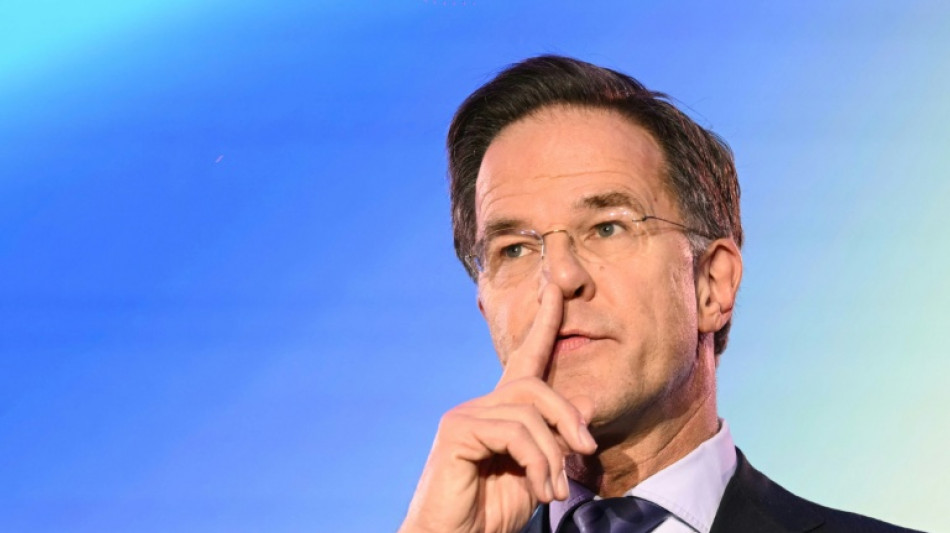
NATO chief's tactic on Trump's Greenland threats? Change topic / Photo: NICOLAS TUCAT - AFP

US President Donald Trump's demands to take over NATO ally Denmark's territory Greenland have thrust alliance chief Mark Rutte into an uncomfortable position.
His strategy for now: say as little as possible and try to change the subject.
Facing warnings the crisis could tear the 76-year-old military alliance apart, the former Dutch premier has sought to keep himself and NATO out of the fray.
Instead, he's tried to deflect Trump's desires by stubbornly focusing on joint efforts to boost Arctic security, dodged tricky questions and even kept on praising the US leader.
That approach hasn't always gone down too well.
At a meeting with members of the European Parliament this week Rutte was repeatedly put on the spot.
"Allow me to address you as the guy who's looking after all of us," said agitated Danish lawmaker Stine Bosse.
"Please give us an indication of what this alliance can do if two countries within the alliance cannot agree?"
Rutte, however, remained unfazed.
"My role as secretary general, I'm very clear -- I never ever comment when there are discussions within the alliance," he stonewalled. "You work behind the scenes."
The alliance chief insisted his energy was squarely on making sure NATO was doing enough to protect the Arctic -- a key justification in Trump's rationale for wanting Greenland.
"I believe there is a bigger issue at stake here, and that is the defence of the high north, the defence of the Arctic area," Rutte said.
He then went even further and repeated his argument that Trump has in fact made NATO's alliance stronger by forcing others to spend more on defence.
"I know you will all hate me now saying this, but this is what I believe," he said.
- 'Keep the Americans onboard' -
That sangfroid is a large part of the reason why Rutte is in the job.
Billed as a "Trump-whisperer", he is one of a handful of European leaders who have been able to win the ear of the unpredictable US president.
The wily political operator converted the goodwill into a major success at NATO's summit this summer by securing a landmark spending deal that kept Trump happy.
Among diplomats at the alliance's headquarters, there is a general understanding of Rutte's low-key approach.
"It's difficult for Rutte to take the lead here as he has to keep the alliance together and keep the Americans onboard," said Jamie Shea, a former senior NATO official now with Chatham House think tank.
"He can't take the European side against Washington."
While some European leaders like Denmark's Mette Frederiksen and France's Emmanuel Macron have been more outspoken -- the concrete steps taken so far have focused on reinforcing NATO's position in Greenland and the Arctic.
Copenhagen has sent more troops to the island and other European powers have dispatched personnel as a possible prelude to a bigger NATO deployment.
Shea said Rutte needs to hammer out the details for a potential NATO mission in the Arctic and get Trump to agree to it as a possible part of the solution.
"He needs to work behind the scenes quickly but quietly to sell the idea to the US," Shea said.
- 'Silver bullet' -
The furore over Greenland comes at a delicate time as Europe grapples with Trump's push to end Russia's war in Ukraine.
After months of nudging, Washington finally seems to have drawn closer to Kyiv's position -- but any progress is fragile.
Meanwhile NATO itself is eyeing a potentially combustible summit with Trump in Turkey this summer where allies will have to show him they're making good on the vow to spend more.
"Rutte knows that if he fails now he could get burnt and lose his capital with Trump," a senior NATO diplomat told AFP.
"He wanted to save his silver bullet for Ukraine, but maybe now will have to try to manufacture another one for Greenland."
But if Trump does eventually press ahead with his threats against Greenland, possibly even resorting to force, the NATO chief may not have an option but to intervene more forcefully.
"Rutte still has a responsibility, which is to decide when he thinks it is most appropriate to chip in," said Camille Grand, another former senior NATO official.
"At the moment, he says he is not getting involved in disputes between member states. That may work for now, but at some point he risks being caught up in it".
The man himself appears to be unperturbed.
"I'm thoroughly enjoying the role and the job," he said, when an EU lawmaker asked if he feared being the last NATO secretary general.
"I was not planning to quit already, but I'm sure there will be a successor someday".
M.Hernandez--GM