US Fed expected to hold rates steady ahead of key midterm elections / Photo: Lillian SUWANRUMPHA - AFP

The US Federal Reserve will announce a decision on setting interest rates on Wednesday, with markets expecting the central bank to hold steady days ahead of crucial midterm elections, despite surging inflation.
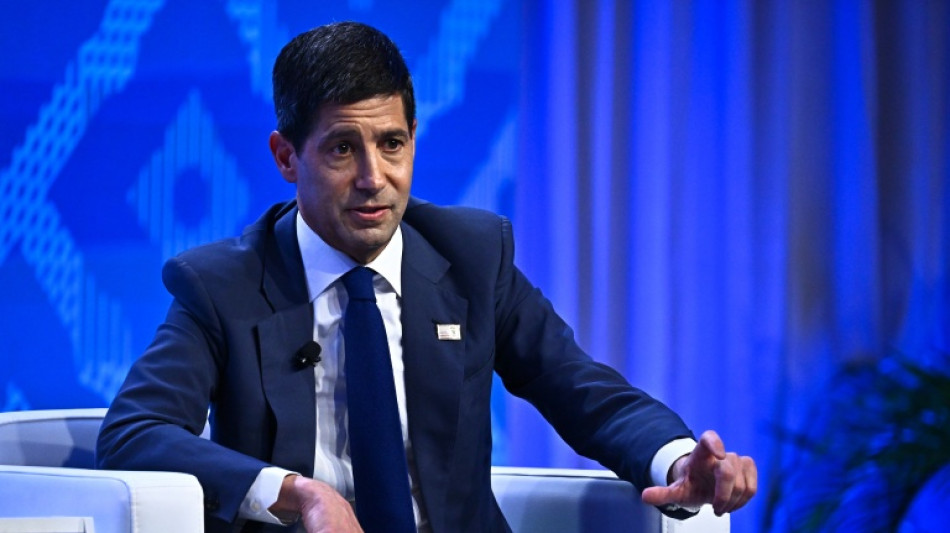
The Fed will announce the decision of the 12 voting members of the Federal Open Market Committee (FOMC) at 2:00 pm local time (1800 GMT) on Wednesday, with a press conference by Chairman Kevin Warsh to follow.
Policymakers voted at their last meeting in September to raise interest rates to a range between 3.75 and 4.00 percent -- the first hike in three years -- to tackle inflation.
The Fed has missed its long-term two-percent target for inflation for more than five years, with households and businesses battered by sustained price increases.
US President Donald Trump's war on Iran, launched in late February, has sent energy prices skyrocketing and fueled domestic inflation, alongside his wide-ranging tariff policies.
Prices have also been driven by an investment boom in artificial intelligence (AI) technology and the build-out of huge data centers to support it.
The Fed's decision comes six days ahead of the November 3 midterm elections, in which the Democratic Party seeks to wrest control of both houses of Congress from Trump's Republicans.
Trump's handling of the economy has been a key issue throughout the campaign, with working-class households across the country struggling to make ends meet despite largely stable overall economic growth.
US consumer inflation came in hotter than expected in September, clocking in at 3.7 percent, edging back towards a three-year high established in May.
Still, key policymakers at the Fed -- including Chair Warsh -- have signaled that they did not see an urgency to raise rates again immediately.
Speaking in Bangkok earlier this month, Warsh said that US economic conditions had "broadly conformed" to policymakers' expectations, fueling speculation that the Fed may pause at the October meeting.
Wendy Edelberg, senior fellow at the Brookings Institution, told AFP that all the signs pointed to a hold.
"I would be very surprised if they raised interest rates just for starters so close to the election, but also given that so many of them have signaled that they're happy for a pause," she said.
- 'Don't understand the logic' -
For Edelberg, however, a decision to hold after raising rates in September would potentially be contradictory, given the labor market -- the Fed's other mandate -- has been largely stable.
"In terms of the economics of it, I don't totally understand the logic," she said.
"If there was a reason to raise interest rates at the last meeting, I think that there's just as compelling of an economic reason to raise interest rates at this meeting."
The Fed has a dual mandate to maintain maximum employment while keeping inflation to its long-term target.
It achieves this goal largely using one tool: the economy's key interest rate. Raising rates tends to cool inflation but can also dampen economic activity; lowering them can spur economic activity but also fuel inflation.
The US unemployment rate has been largely stable around 4.2 percent over the last year, with job growth mostly in positive territory -- albeit driven by a few sectors.
Loretta Mester, former head of the Cleveland Fed, agreed that current economic conditions gave policymakers an opportunity to press ahead with rate hikes now.
"Take advantage of the situation you're in today, which is pretty clear evidence of stability in the labor market, and clear evidence that inflation is still too high," she said.
"Move, given that you know you want to be moving more, take the advantage of this meeting."
Mester, who took part in FOMC meetings during her tenure at the Fed, insisted that the committee did not "take into account any kind of political issues" when it debated monetary policy.
- Attacks on Fed -
Still, Trump has loomed large over the Fed since he returned to power last year.
In his second term, he has led an unprecedented assault on the Fed's independence, pursuing criminal charges against Warsh's predecessor Jay Powell and attempting to fire Fed Governor Lisa Cook as he demanded lower interest rates.
While the probe against Powell was dropped to smooth the way for Warsh's Senate confirmation, the White House has recently renewed its drive to fire Cook -- despite a Supreme Court decision that batted back an earlier attempt.
"I don't think it's going to stop because I think it's in the nature of this administration to continue those attacks," said Mester.
Y.Herrera--GM