What rainbow? LGBTQ Indonesians on edge as hostility mounts / Photo: JUNI KRISWANTO - AFP

Indonesian doctor "Pierre" says he is always on edge. He is gay, but hides it, with anti-LGBTQ sentiment on the rise in the Southeast Asian country.
Not even his parents know.
Indonesia has witnessed a spate of very public attacks on transgender women and gay people, pushing a community long used to living in the shadows even deeper underground.
The pressure is coming from all angles.
The government has issued a regulation classifying LGBTQ groups as a "threat", public officials have no qualms making disparaging remarks and lawmakers are mulling proposals from Islamic leaders to criminalise sexual "deviancy".
"As part of the queer community, I feel unsafe," the young doctor from Java island told AFP.
Out of fear, he agreed to be interviewed on condition AFP does not use his real name or reveal his location. He picked the moniker "Pierre."
"I self-censor on social media. Before I repost certain photos, I think about whether it could trigger questions" among colleagues or friends about his sexuality.
"Pierre" said he has to watch his mannerisms and no longer wears shorts or pink clothes -- items that could be perceived as not manly.
"I feel very limited in expressing myself. I don't want to feel like this."
LGBTQ people have long been outcasts in the world's most populous Muslim-majority country.
There are no official statistics, but rights groups say the violence -- verbal and physical -- has never been worse.
In recent weeks, Amnesty International Indonesia reported attacks on about a dozen transgender women in Bogor near the Indonesian capital Jakarta.
Some of the women were stripped naked or had glass bottles thrown at them; others had young men urinate on them.
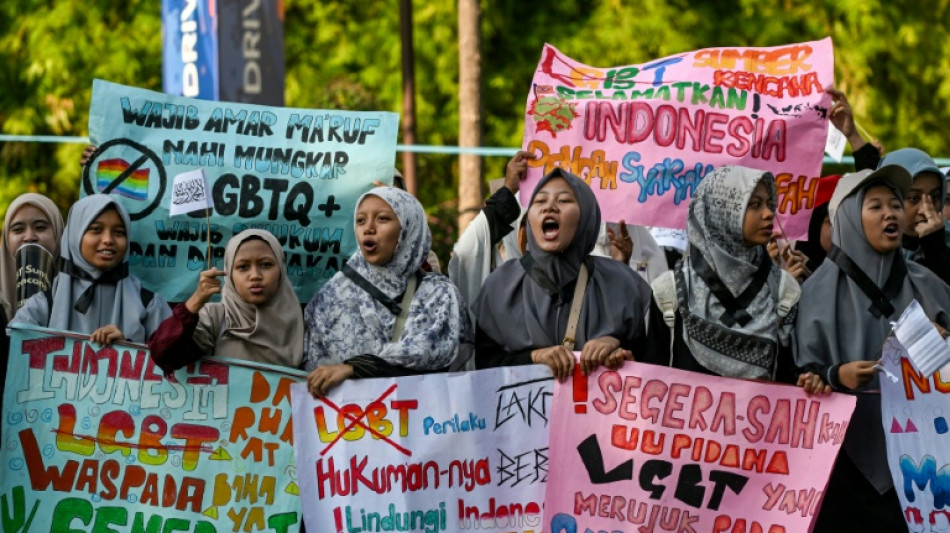
Social media is replete with videos of youths calling themselves "Boti hunters" who roam the streets of Indonesian cities brandishing anti-LGBTQ posters and spreading fear.
"Boti" is a derogatory Indonesian word for gay men.
The Arus Pelangi LGBTQ advocacy group said it had registered 94 cases of violence with 141 victims in 2024 and 2025.
"Those are only the number of cases reported to us," said the group's spokeswoman Echa Waode.
"Can you imagine how many cases have not been reported?"
- 'The scapegoat' -
Observers say anti-LGBTQ crusaders feel they have political license.
Last October, President Prabowo Subianto issued a decree that classified "the spread of Lesbian, Gay, Bisexual, Transgender, and Queer (LGBTQ) culture" as a "non-military threat" to the state.
The Ministry of Religious Affairs has said it is preparing educational materials "to prevent the spread of LGBT culture" in public schools.
For observers such as Usman Hamid, Amnesty International Indonesia's executive director, this is all political deflection.
"It's another tactic from the authoritarian playbook: diverting public attention, distracting people from fundamental issues like unemployment, economic slowdown, fuel shortages," Usman told AFP.
"So instead of blaming the government, people end up blaming whoever is being made the scapegoat."
The consequences are very real.
In June, students at a university in Jakarta held rallies to demand the expulsion of a classmate seen kissing another man in the campus library.
The university said it would investigate the incident, a video of which went viral, and the student's father reportedly came to campus to prostrate himself in apology.
"Pierre" said people's health was being put at risk.
"Queer people are getting more and more afraid to go to healthcare facilities, and in the end a lot of them kind of don't know their status" when it comes to sexually-transmitted diseases.
"This discrimination can really affect people's health; it can even be a matter of life or death," he said.
Activist Dania Joedo told AFP it was not uncommon for LGBTQ people to have bottles thrown at them, to be urinated on or beaten up, even tasered.
"The state... oppresses, and then society accepts the narrative that violence against queer groups can be normalised," said Dania, a trans woman herself.
Religious and political conservatives refuse to budge.
"Indonesia is in an LGBTQ emergency, and we want to eliminate LGBTQ from Indonesia," Indra Zulfanudin, the founder of a youth group calling itself Bogor Clean LGBTQ, told AFP.
"They are a bad influence, especially on teenagers."
- 'Propaganda' -
Some 242 million Indonesians, nearly 90 percent of the population, are Muslim, and most of the rest are Christian, Hindu, Buddhist or Confucian.
"Opposition to LGBTQ people isn't new... Most of our national religions oppose their existence," Dede Tresna Wiyanti, an anthropologist from Padjadjaran University, told AFP.
Indonesia's coordinating minister for law, human rights, immigration and correctional institutions, Yusril Ihza Mahendra, has denied the presidential regulation targets LGBTQ people.
"We respect their rights, and their existence... There must be no discrimination, no persecution, no violence, no threats against people who are categorised as part of LGBTQ," Yusril told AFP.
"What is presented as a non-military threat is the propaganda spreading the ideology and lifestyle of LGBTQ itself. That is what the government is trying to counter."
For Pierre and others like him, the hostility is oppressive.
"I am proud of my heritage as an Indonesian. But these days I realise that my love for this country might not be reciprocated," he said.
F.Martinez--GM