Syria, Jordan agree to mend ties after deadly strike / Photo: Bakr ALkasem - AFP

Syria and Jordan announced on Tuesday they were determined to maintain good relations, after the Jordanian military conducted deadly strikes on its neighbour in retaliation for a gun attack on a church.
The strike sparked the worst crisis between the two countries since the ousting of longtime Syrian ruler Bashar al-Assad in December 2024, though Jordan said earlier Tuesday that it had "great respect" for its neighbour and expressed regret for civilian casualties.
Syria had condemned Jordan's strike on the south as an "unacceptable violation", while Jordan said it killed more than 20 jihadist fighters in its raid.
Last week, gunmen opened fire during a funeral service at a Greek Orthodox church in southern Jordan's Karak governorate, killing nine people and wounding 25 others.
While Jordan insisted it coordinated its airstrikes with Syria, Damascus denied the claim, and Syria's civil defence agency said the raids killed seven people including three children.
Later on Tuesday, Jordan's Foreign Minister Ayman Safadi contacted his Syrian counterpart, Assaad al-Shaibani, according to a joint statement published by the Syrian ministry.
According to the statement, Safadi emphasised "Jordan's full respect for Syria's sovereignty... and security", while also expressing "sorrow and grief over the death of innocent civilian victims".
The two officials also discussed the raids against what the statement branded as "Daesh sites", using an acronym to refer to the Islamic State (IS) group.
Earlier, Jordan's government spokesman Mohammad al-Momani had said that "the preliminary results... indicate significant losses among Daesh's ranks -- estimated at more than 20 fighters".
He also said "a large weapons depot belonging to the organisation" had been destroyed.
- 'Blatant violation' -
Earlier, Syria's foreign ministry issued a "condemnation and rejection" of the strikes, calling them "an unacceptable violation and breach of Syrian airspace without any prior coordination".
It also said the raid was "a blatant violation of the principles of good-neighbourliness and Syrian national sovereignty".
Amman appeared keen to put an end to the crisis, with Momani saying that "Jordan holds great respect for the Syrian state and its brotherly people".
In the coming days, a joint Syrian-Jordanian security committee will meet to discuss the operations against IS, a government source told Syrian state news agency SANA.
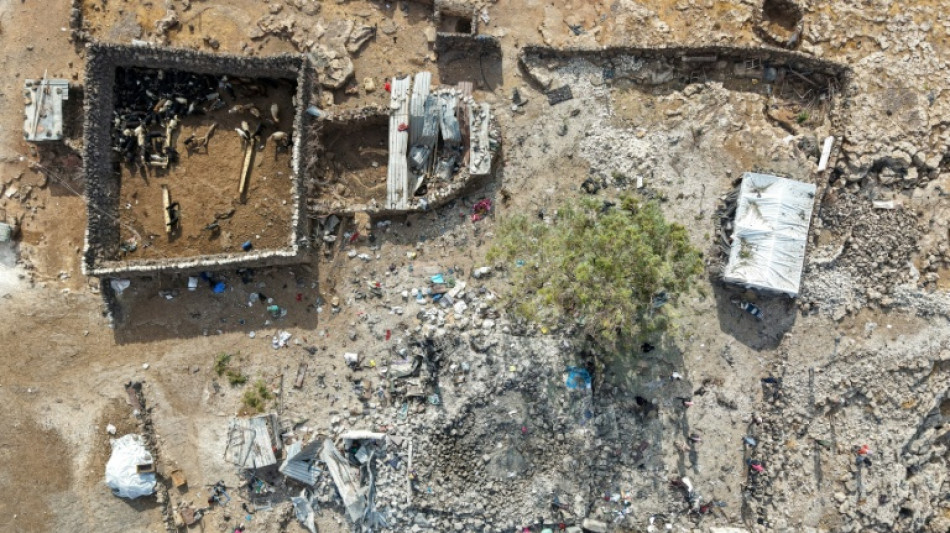
Syria said five people including a woman and three children were killed in the village of Al-Taf in Daraa province, which borders Jordan, with two other people killed elsewhere in the south.
"We were asleep when the missile hit us. My mother, my older brother and his three children -- two boys and a girl -- were killed," said Nassouh al-Salim in Al-Taf, staring at a grey body bag.
An AFP reporter saw a huge crater in the family's destroyed home, with school books, clothes and the remains of furniture strewn among the rubble.
After the strikes, Syria closed its main Nassib border crossing with Jordan, known as Jaber on the Jordanian side, suspending all passenger and commercial traffic in both directions, citing "the current circumstances".
But Syrian Emergencies and Disaster Management Minister Raed al-Saleh said later Tuesday that both sides were handling the dispute through "diplomatic and legal channels" with the aim of securing justice for the victims.
- 'Dark ideologies' -
On Monday, Amman said authorities had arrested three Jordanians accused of the church killings, two of them brothers and the other related by marriage.
Authorities said the suspects were hospitalised after being wounded in a shootout with security forces.
Karak is home to a significant Christian community in Muslim-majority Jordan, where Christians make up between two and three percent of the population.
"We vowed the terrorists would not escape punishment, and no proponent of dark ideologies that divide Jordanians will be tolerated," Jordan's King Abdullah II said.
IS was territorially defeated in Syria in 2019, after it seized swathes of territory during the country's more than 13-year civil war.
But remnants are still present there and the group occasionally claims attacks, mainly targeting Syrian security forces.
The group has previously been present in parts of Daraa province.
burs-ser-lg/jfx
C.Morales--GM